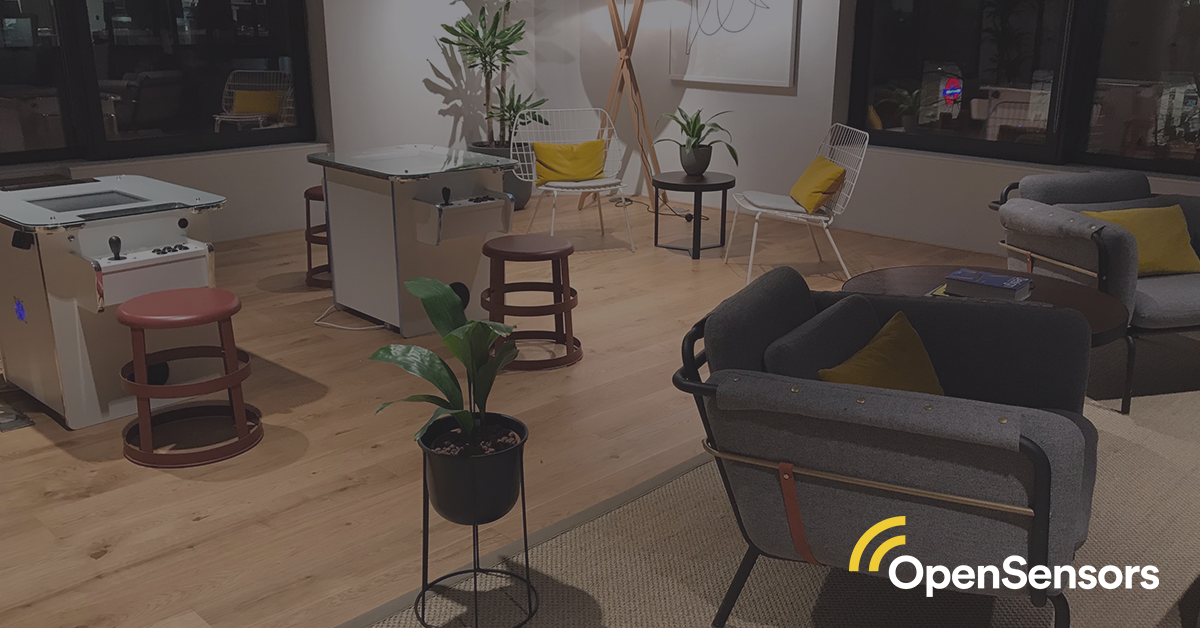
Today’s workforce is rapidly changing. Employees expect to have a choice of where to work and organisations need to be adaptable to attract and retain talent. Here’s how Occupancy technology can help increase utilisation rates.
Benefits of using occupancy sensors
Occupancy data using sensors gives deeper insights into patterns of how the workforce uses its space. Sensors have been shown to measure space utilisation rates much more accurately and efficiently, giving facility management teams flexibility to:
- Better manage space capacity with a growing workforce
- Maximise building occupancy and prove value to the business
- Find smarter ways to lower resource and operational costs
- Demonstrate return on investment
- Understand the impacts of environmental factors to wellness
Balancing the needs of employee experience with the need to use the offices to optimum levels can be a challenge as site managers have to weave a balance between under-utilised offices, where the industry norm is >50%, and over utilisation where people can’t find space to work.
From connecting and linking to heating, ventilation and air conditioning systems (HVAC) to lighting, environmental sensors, security and safety equipment – these solutions provide businesses with factual data to make informed operational decisions as well as:
- Align business goals and costs with other departments and business unit leaders to better utilise workspaces
- Be in control to understand how building, floor space, meeting rooms and desks are utilised across locations and teams
- Influence stakeholder conversations with data driven recommendations on how to optimise workspaces to boost employee productivity
- Future proof buildings or workspace redesigns and create fit for purpose spaces
- Accurately measure person to desk ratio and easily find space for new joiners
- Benchmark with real data to drive down the cost of under-utilised spaces
- Support activity based working practices by pinpointing peak hours and encourage work from home
- Make life easier for employees with real time feeds of available desk or meeting rooms across all locations
By taking away the guesswork, corporate real estate, facility and workplace teams are better equipped to make decisions on future strategies and accommodate a growing workforce.
4 key metrics to measure workplace occupancy
We recommend to start with defining your goals and the metrics you want to measure. This will help you determine the right type of occupancy sensor(s) needed as well as the data points to monitor and report on. Some key occupancy metrics you may want to measure are:
- Average utilisation rates of desk, meeting rooms or shared spaces
- Peak vs. off peak utilisation rates
- Person to desk ratio
- Utilisation comparison between buildings, floors, departments or teams
5 ways to increase desk utilisation rates
- Allocate fixed desk to flexible desks – as your workforce grows you can accommodate them using flexible desk space, thus, increasing your person to desk ratio and reducing the need to rent additional office space.
- Increase person to desk ratio across different teams – every team or department within a company operates differently and assessing how each currently use workspaces can give you insight into the varying occupancy rates across departments.
- Allocate space on demand – less than a handful of suppliers offer floor level heat map data as a way to help businesses visually see in real time what spaces may or may not be in use. If this is available to you, use this information to identify workspaces that could be used as an overflow buffer during peak times.
- Compare site utilisation – If you manage more than 1 building site then you want to know how well the space is being utilised as costs to maintain different locations is huge. By comparing the occupancy rates you can make informed decisions around re-allocating users and investment.
- Use data to have conversations with business unit leaders – with more data backed evidence in hand you can have better conversations with business unit leaders, using the utilisation comparison to shift conversations from ‘how many desks do you need’ to ‘how can you use your space more productively’.
Key takeaways
- A connected workforce is driving a change in work patterns and organisations need to adapt the work environment to match expectations in order to attract the best talent.
- Using occupancy sensors is the way forward to optimise space planning.
- Measure the right metrics against your hypothesis in order to see shifts in your workplace utilisation rates.
Need to measure how your workspaces are utilised?
Contact us to speak to a member of our team. Or if you’d like to learn more about space utilisation here’s a short webinar on how to measure workplace occupancy.
{{cta(‘2ec57535-684a-46e7-a25b-42ccdfa850df’)}}