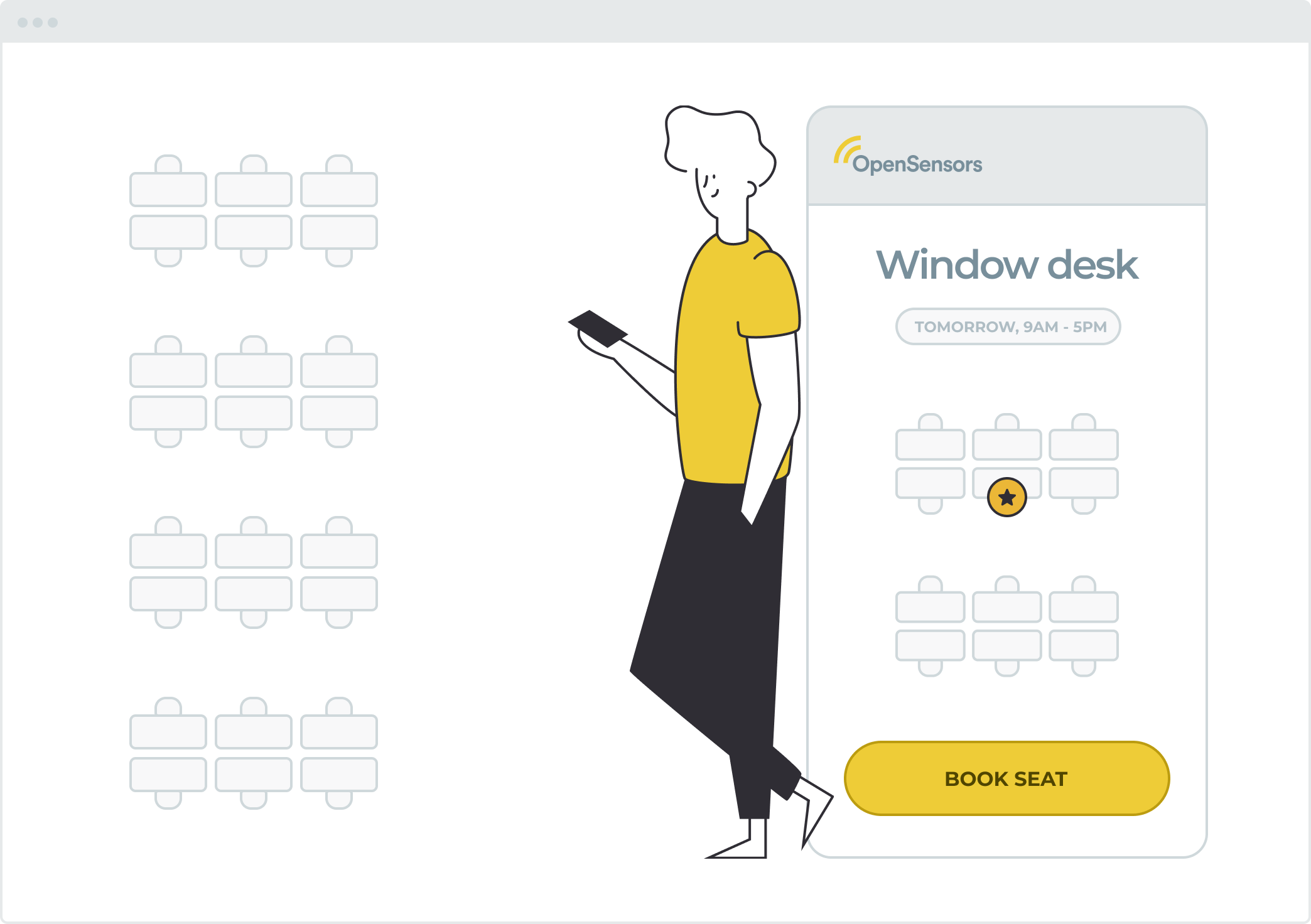
Managing flexible workspaces quickly becomes a significant and arduous task if the appropriate tools are not put into practice.
Here’s why you need an intelligent booking system that enables teams responsible for space management to create highly reactive and agile workplaces.
1. Automating tedious administrative tasks
The move away from traditional 1:1 desk to person workplaces has given rise to a series of new daily administrative challenges. To avoid employee frustration and unnecessary delays to projects, teams need to ensure that maximum capacity is not exceeded and that employees know where they are due to be working.
Managing this process manually becomes a logistical nightmare as occupancy levels rise and increasing numbers of assets, rooms and spaces are entered into the equation. Our booking tool automates these processes, streamlining the entire user and managerial experience by providing a centralised point of access to the workplace.
Employees no longer need to seek managerial approval for their bookings, as their user settings and preferences are logged in the system. As and when employees edit or cancel their bookings the system takes care of the alterations.
It becomes immediately apparent which spaces are available when, and managers are able to quickly and easily look ahead at future occupancy levels.
Furthermore, occupancy sensors built into the system detect when a booked space is unused, meaning that spaces which would otherwise sit empty all day are released back into the system.
2. Understanding spatial requirements
By integrating occupancy sensors into its booking tool we enable teams to have more than an understanding of how spaces and assets are utilised throughout the week, but also the demand for spaces and insights into the impact of no shows on space requirements.
Comparing booking data against utilisation metrics allows teams to understand precisely how, where and when employees are choosing to work and provide the appropriate array of assets to meet demand.
Additionally, gathering information on the frequency of no shows leads to more productive internal conversations regarding departmental or company wide policy, as space managers are equipped with the data necessary to leadership teams to highlight and correct the problem.
3. Spreading occupancy evenly throughout the week
The rise of flexible work has led immediately to a new dominant working week pattern, in which offices are vastly underutilised on Mondays and Fridays, and approach full capacity during the midweek.
As a result of this, organisations are unable to reduce their real estate square footage to cater to average utilisation, as peak occupancy must be accounted and prepared for.
Spreading occupancy more evenly across the week leads to a far more effective use of space, and leaves organisations free to either downsize or repurpose the surplus space.
Gathering booking and occupancy data enables organisations to understand how teams and departments are using the space, and develop mobility profiles which guide how and when individuals are able to access the workplace.
Our booking tool then enables teams to act on this information, as user permissions can be adjusted and set to avoid overcrowding in the week.
It is important however, to acknowledge that these systems cannot be fully rigid as individual employees’ working lives are prone to last minute changes. As such, we recommend providing a series of spaces which are always bookable by anyone who needs them.
4. Safeguarding employee health
In the era of COVID19, it is vital that organisations are putting the necessary measures in place to protect employees from illness. In the case of infection, our booking tool provides teams immediately with all the information they require to follow track and trace procedures.
Furthermore, booking tools act as a single point of access to the workplace, so should capacity need to be capped during the colder months, it is a quick and simple process for teams to remove assets from the system to control peak occupancy.